The Rolex Yacht-Master II is one of the most technically distinctive watches Rolex has ever produced — and one of the most misunderstood. Reference 116680, introduced in 2007 and updated in 2017 with a Chromalight dial and Maxi case, is the all-stainless-steel execution: a 44mm Oyster case, a blue Cerachrom ceramic bezel with the rotating Ring Command system, a white lacquer dial with a programmable mechanical regatta countdown, and the in-house Caliber 4161 movement that drives it. This deep-dive walks through the Yacht-Master II's history, the patented Ring Command bezel mechanism, the regatta chronograph's actual function, the specifications of the 116680, and the market context for a buyer evaluating this piece in 2026.
A Brief History of the Yacht-Master II
The Yacht-Master line itself was introduced in 1992 with reference 16628, a precious-metal sport watch derived from the Submariner that staked Rolex's claim in the yachting category. For fifteen years, the Yacht-Master was a time-and-date watch — a luxury sport piece without a complication tied to its name. That changed in 2007 with the introduction of the Yacht-Master II, the first Rolex chronograph since the Daytona, and the only Rolex chronograph ever built specifically around a regatta countdown rather than general elapsed-time measurement.
The Yacht-Master II launched as reference 116688 in 18-karat yellow gold, followed by 116681 in steel and Everose gold, 116689 in 18-karat white gold, and 116680 in stainless steel. The complication at the center of the watch — a programmable countdown timer from 1 to 10 minutes that can be synchronized to the official starting sequence of a yacht race — was, and remains, unique in production watchmaking. Rolex filed multiple patents on the Ring Command bezel system that programs the countdown, and on the mechanical memory function that allows the countdown to be reset to a previously programmed time at the press of a single pusher.
In 2017, Rolex updated the 116680 with a "Maxi" case (broader lugs, larger crown guards), a Chromalight luminous treatment that glows blue rather than green in low light, and a refined dial layout. The current Forever Rox example is from 2018 — the early production run of this updated configuration, with the blue Cerachrom ceramic bezel that replaced the earlier platinum-coated blue bezel on the steel variant. According to Rolex's own technical history, the Yacht-Master II remains in current production in 2026, making it one of the longest-running chronograph references in the modern Rolex catalog.
The Regatta Chronograph: What the Yacht-Master II Actually Does
Most chronographs measure elapsed time forward from zero. The Yacht-Master II measures elapsed time backward — counting down from a programmable starting point — and then transitions automatically into a forward-running chronograph the moment the countdown reaches zero. This is the regatta function, and it is the entire reason the watch exists.
In yacht racing, the start of a race is governed by a series of audible signals (horns, cannons, or radio calls) at fixed intervals before the official start: typically a 10-minute warning, a 5-minute warning, a 1-minute warning, and the start itself. Skippers do not cross the start line at the start signal — they jockey for position during the countdown, attempting to cross the line at the exact moment the start signal fires while still on the windward side of the line. A boat that crosses early is penalized; a boat that crosses late surrenders distance. Regatta countdown timers, mechanical or electronic, are a standard piece of racing gear.
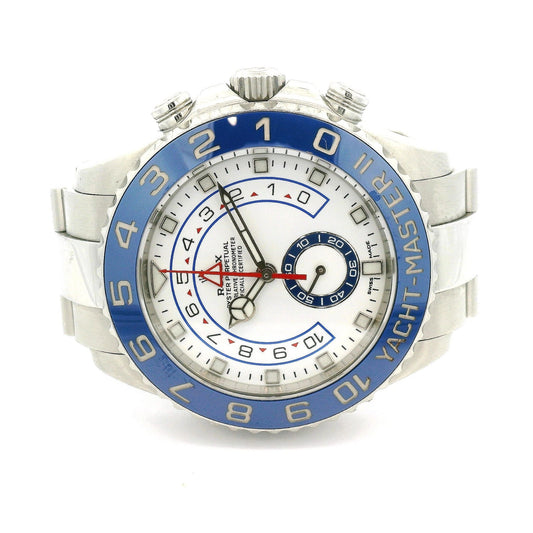
The Yacht-Master II's central regatta minute hand — the long red-tipped hand that sweeps across the upper portion of the dial — counts down from a programmed starting time (1 to 10 minutes, set in 1-minute increments). The countdown is read against the upper arc of Arabic numerals printed on the dial, which runs from 10 down to 0. A small seconds sub-register at 6 o'clock provides the running seconds during the countdown. When the countdown reaches zero, the same hand continues sweeping forward as a conventional chronograph minute hand, allowing the wearer to measure the elapsed time of the race itself.
The synchronization feature — the patented part — is what makes the watch genuinely useful at the start of a race rather than just visually impressive. If the wearer presses the lower pusher during the countdown, the countdown hand snaps to the nearest minute marker, allowing on-the-fly correction if the actual race countdown drifts off from the watch's countdown. The mechanical memory then preserves the original programmed countdown time, so the next race can be restarted at the same setting without reprogramming.
The Ring Command Bezel: Setting the Countdown
The Yacht-Master II's bidirectional rotating bezel is not a decorative or timing bezel — it is the actual programming interface for the countdown. The bezel rotates 90 degrees to engage with the movement, and once engaged, becomes the input mechanism for selecting the countdown duration. This is Rolex's patented Ring Command system, and the 116680 was the watch that introduced it to the Rolex catalog before it later appeared (in modified form) on the Sky-Dweller.
To program the countdown, the wearer unscrews the crown, rotates the bezel to engage, and uses the crown to set the desired countdown time (1 through 10 minutes) on the dial. Rotating the bezel back disengages it from the movement, locking the program in. The chronograph pushers then operate the start, stop, reset, and synchronization functions during use. This means the Yacht-Master II has two physical interfaces — the crown and the bezel — that both interact with the movement, controlled by two separate clutches inside the case. It is a mechanically dense system, and one of the reasons the watch carries a higher service complexity rating than a standard Submariner or Datejust.
The bezel itself on the 116680 is blue Cerachrom — Rolex's proprietary ceramic, virtually scratchproof and color-stable under prolonged UV exposure. The Arabic numerals around the bezel are engraved into the ceramic and filled with platinum via PVD deposition, which is what gives them the slightly bright, three-dimensional metallic finish under direct light. Earlier 116680 production (2007 to 2017) used a different bezel insert process; the 2017+ Cerachrom is the version on this Forever Rox piece.
The 116680 Case, Dial, and Crystal
The Oyster case on the 116680 is 44mm in diameter, machined from Rolex's proprietary 904L stainless steel (which Rolex now markets as "Oystersteel" for trademark reasons). The case carries a thickness of approximately 14.6mm, a lug-to-lug of roughly 53mm, and the post-2017 "Maxi" geometry — broader lugs and larger crown guards than the 2007–2016 production. Water resistance is rated to 100 meters via the Triplock triple-gasket screw-down crown system. The crystal is scratch-resistant sapphire with the small Cyclops lens magnifying the date window at 3 o'clock.
The dial is white lacquer, with the regatta countdown architecture printed in blue and red and the small running seconds sub-register at 6 o'clock printed with concentric blue arcs and a blue inner bezel ring. Applied hour markers run around the dial's perimeter in 18-karat white-gold-encircled luminous square indices. The hands are the iconic Rolex "Mercedes" geometry — broad luminous hour and minute hands, with the running seconds indicator and the chronograph minute countdown hand carrying red tips. Chromalight luminous treatment provides the blue glow in low light.

The "ROLEX OYSTER PERPETUAL DATE" wordmark sits below 12 o'clock, and "YACHT-MASTER II" prints in red below it — the only red text on the dial besides the chronograph hand tips. "SWISS MADE" runs along the lower edge at 6 o'clock. The "YACHT-MASTER II" engraving on the bezel itself, filled in platinum PVD, faces outward toward the wearer's view rather than printed on the dial — a deliberate design choice that lets the dial focus on the regatta function while the model name lives on the bezel.
The Caliber 4161 Movement
Under the solid Oyster caseback, the Yacht-Master II runs the Rolex Caliber 4161 — a fully integrated, in-house, automatic flyback chronograph designed and built specifically for this watch and produced nowhere else in the Rolex catalog. The 4161 is one of the most mechanically dense modern Rolex movements: 360 components, 44 jewels, a 72-hour power reserve, a 4 Hz (28,800 vph) frequency, and the patented mechanical programmable countdown memory that allows the regatta function to operate.
The chronograph architecture is a column-wheel and vertical clutch design — the same modern standard Rolex uses across its in-house chronograph calibers (the 4130 in the Daytona and the 4131 in the current Daytona). Vertical clutch chronographs eliminate the small "stutter" of chronograph hand engagement found in horizontal clutch designs, allowing the central regatta minute hand to start instantly and smoothly when the chronograph pusher is depressed. The column wheel governs the sequence of start, stop, reset, and synchronization, providing the crisp tactile feel at the pushers that the watch is known for.
The 4161 also incorporates Rolex's Parachrom blue hairspring, a paramagnetic niobium-zirconium alloy that resists magnetic interference and shock significantly better than traditional steel hairsprings. The movement is COSC chronometer-certified and additionally tested in-house to Rolex's "Superlative Chronometer" standard — accuracy to within -2/+2 seconds per day, two to three times tighter than COSC's -4/+6 specification. This certification was applied to the 116680 starting with the 2015 production updates and is engraved on the lower edge of the dial as "SUPERLATIVE CHRONOMETER OFFICIALLY CERTIFIED" under the Rolex crown.
The Reference Decoded: 116680
Rolex's reference numbering encodes case material, case generation, and bezel type. For ref. 116680:
11 identifies the Yacht-Master II case family — the 44mm sport chronograph case with crown guards and the Triplock crown system.
66 indicates the bezel and crown configuration specific to the Yacht-Master II — bidirectional Ring Command rotating bezel with screw-down crown.
80 designates the case material — full stainless steel (Rolex 904L / Oystersteel). The other reference numbers in the Yacht-Master II family use different final digits for case material: 116681 (steel and Everose gold), 116688 (yellow gold), and 116689 (white gold).
The watch is sometimes catalogued as "116680-0002" with the suffix designating the specific dial and bezel configuration (white dial, blue Cerachrom bezel), but the four-digit core reference 116680 is the primary identifier most dealers, auction houses, and collectors use.


Bracelet and Wearability
The 116680 ships on the Rolex Oyster bracelet in 904L Oystersteel — the three-link bracelet originally designed for the original Oyster in the 1930s, refined across nearly a century of production. The center links are polished; the outer links are brushed. The bracelet is finished with the Oysterlock safety clasp and the Easylink 5mm comfort extension, allowing the wearer to adjust the bracelet length by 5mm without tools as wrist size fluctuates throughout the day. The clasp folds flat and carries the Rolex crown signed on its exterior face.
At 44mm in diameter, 14.6mm thick, and approximately 53mm lug-to-lug, the Yacht-Master II is one of the larger production Rolex sport watches — meaningfully bigger than a Submariner (40-41mm) or a GMT-Master II (40mm), and closer in scale to the Sea-Dweller Deepsea (44mm) or the Sky-Dweller (42mm). The Maxi case generation introduced in 2017 widened the lug structure further, which means the watch wears its diameter more confidently on larger wrists and feels more present on smaller ones than the pre-2017 production. On a 7-inch wrist, the Yacht-Master II wears as a full sport chronograph without overhanging; under 6.5 inches, the 53mm lug-to-lug starts to push against the wrist bones. The Oyster bracelet's tapered link geometry helps the watch sit more comfortably than its top-down dimensions might suggest.
The Example Currently in the Forever Rox Fine Jewelry Showcase
We currently have a 2018 example of reference 116680 in our case at 930 Tahoe Blvd. in Incline Village. The piece is in excellent pre-owned condition with the full set: original Rolex box and papers. The 44mm Oystersteel case carries the post-2017 Maxi profile with the blue Cerachrom ceramic bezel intact and unscratched, the white lacquer dial is original and unrestored with all Chromalight applications correct, and the watch retains its original Rolex Oyster bracelet with the Oysterlock clasp and Easylink extension. The Caliber 4161 movement runs to Superlative Chronometer spec.