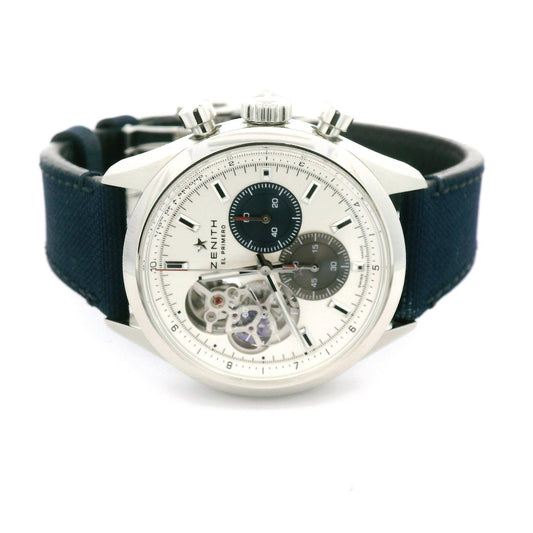
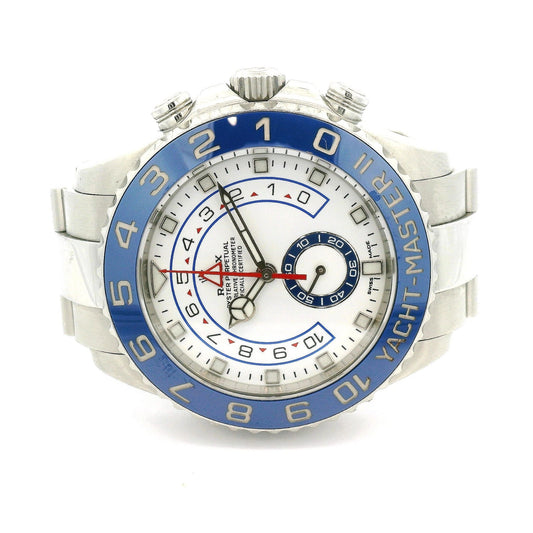
The Zenith El Primero is one of the most consequential mechanical watch movements ever produced. The Chronomaster Open is the reference that made the El Primero visible — literally — by cutting an aperture through the dial to expose the high-frequency escapement at work. Reference 03.3300.3604/69.C823 is the 2024 39.5mm steel execution of that idea, paired with a silver dial, blue cordura-effect strap, and the latest 1/10th-of-a-second El Primero 3604 caliber. This deep-dive walks through the movement's history, the Chronomaster Open's design lineage, the technical specifications of this specific reference, and the market context for a buyer evaluating this piece in 2026.
A Brief History of the El Primero: The Movement That Refused to Die
On January 10, 1969, Zenith unveiled the El Primero — Spanish for "the first" — at a press conference in Le Locle, Switzerland. It was the world's first fully integrated, automatic, high-frequency chronograph movement, and it arrived in a dead heat with the Heuer-Breitling-Hamilton-Buren consortium's Caliber 11 and Seiko's 6139. Of the three, the El Primero was the only one beating at 36,000 vibrations per hour — a 5 Hz escapement that allowed the movement to time events to 1/10th of a second, a level of precision no production automatic chronograph had achieved before. The El Primero was, and remains, a watershed engineering achievement.

According to Time and Watches, Zenith produced approximately 32,000 El Primero movements across 18 different models between 1969 and 1975 — a respectable run, until the Quartz Crisis hit. By the mid-1970s, Zenith's American owners (then the Zenith Radio Corporation) had decided the future was quartz. In 1975, management ordered the El Primero tooling, dies, and technical drawings destroyed.
Charles Vermot, a senior watchmaker at the Le Locle manufacture, refused. As Grail Watch documented in Vermot's own words, he and his brother Maurice spent night shifts secretly hauling the presses, cams, cutting tools, and operating plans up 52 stairs into a walled-off room on the top floor of one of the manufacture's 18 buildings. He hid the entire production capability for the El Primero in that attic and walled it shut. He was, by every measure, violating direct orders from ownership.
The decision saved Zenith. When mechanical watchmaking came roaring back in the 1980s, Zenith was one of the only Swiss manufacturers with a fully tooled, in-house, high-frequency automatic chronograph movement ready to go. In 1986, Rolex selected the El Primero (modified, with the frequency reduced to 28,800 vph for serviceability) to power the new generation of the Rolex Daytona, beginning with reference 16520 — the so-called "Zenith Daytona," produced from 1988 to 2000. That single contract may have done more to cement the El Primero's reputation in collector circles than any marketing campaign Zenith ever ran.
In 1999, LVMH acquired Zenith, and the brand has spent the last quarter-century mining the El Primero's legacy across an expanding family of references — the Chronomaster, the Defy, the Pilot, and the modern Chronomaster Sport and Chronomaster Original lines, each of which traces directly back to that 1969 caliber and Vermot's act of preservation.
The Chronomaster Open: Putting the El Primero on Display
The Chronomaster Open was first introduced in 2003. The premise was simple and audacious: cut an aperture through the dial between roughly 9 and 11 o'clock to expose the El Primero's escapement — the balance wheel, the escape wheel, the pallet lever — to the wearer. The 5 Hz balance, oscillating ten times per second, is one of the few mechanical movements where the rate of motion is genuinely visible to the naked eye. The Open dial turned the El Primero from a movement under glass into a movement on display.
For nearly two decades the Chronomaster Open lived alongside the closed-dial Chronomaster Original and various sport-oriented El Primero references in Zenith's catalog. Then at Watches & Wonders Geneva in 2022, Zenith re-launched the Chronomaster Open in a comprehensively redesigned 39.5mm case, with the latest-generation El Primero 3604 caliber visible through both the dial aperture and a new sapphire caseback. The 2022 redesign tightened the case proportions, refined the lugs, and updated the dial layout to align with the modern Chronomaster Original and Chronomaster Sport collections — most notably, the iconic tricolor subdial pattern that has been part of El Primero DNA since 1969.
The reference at Forever Rox Fine Jewelry — 03.3300.3604/69.C823 — is from this current 39.5mm generation, dated 2024.
The El Primero 3604 Caliber: What Sets It Apart
The El Primero 3604 is the latest evolution of the 1969 movement and powers every current-generation Chronomaster Open. It is a direct technical descendant of the El Primero 3600 introduced with the Chronomaster Sport in 2021, modified to drive the central 1/10th-of-a-second chronograph hand specifically.

Per the published specifications confirmed across Prestige Time, Wempe, and Zenith's own technical documentation: The 3604 is a fully integrated, automatic, column-wheel chronograph with a 5 Hz /36,000 vph high-frequency escapement. It carries 35 jewels and delivers a 60-hour power reserve. The escape wheel and pallet lever are made of silicon, which is non-magnetic and lubricant-free — a meaningful improvement in service intervals and timekeeping stability. The balance wheel features a stop-second mechanism for precise time-setting, and the entire movement is COSC chronometer-certified.
The defining functional feature is the 1/10th-of-a-second chronograph display. Rather than the traditional approach of a small foudroyante subdial, the 3604 drives the central chronograph seconds hand at one full rotation every ten seconds — making the chapter ring's 1/10th scale (visible at the dial periphery, with the marking "1/10TH OF A SECOND") readable directly off the central hand. The chronograph hour and minute counters live in the subdials.
The movement is finished with an open base plate and bridges that allow the high-frequency escapement to be visible through the dial aperture, and the sapphire caseback exposes the column wheel, the chronograph levers, and Zenith's signature star-shaped oscillating rotor.
The Reference Decoded: 03.3300.3604/69.C823
Zenith's reference numbering system encodes the entire configuration of the watch. For ref. 03.3300.3604/69.C823:
03 indicates the case material — stainless steel.
3300 identifies the case style and collection — the current-generation Chronomaster Open 39.5mm case.
3604 identifies the movement — El Primero caliber 3604, the 1/10th-of-a-second column-wheel chronograph with silicon escapement.
69 designates the dial variant — in this case, the matte silver dial with tricolor subdials and the open aperture exposing the escapement.
C823 designates the strap configuration — the blue cordura-effect rubber strap with leather backing and steel folding clasp.
Other dials and straps in the same 3300 case carry different suffix codes — the black-dial-on-bracelet variant, for example, is 03.3300.3604/21.M3300, and the boutique blue dial is 03.3300.3604/51.M3300. Knowing the suffix is the cleanest way to identify exactly which Chronomaster Open variant a buyer is looking at.
Case, Dial, and Crystal
The case is 39.5mm in diameter and 13.6mm thick, machined from stainless steel with brushed top surfaces and polished case sides and bevels. The lug-to-lug dimension keeps the watch wearable on a wide range of wrist sizes — a marked improvement over the larger 42mm Chronomaster Open references that preceded the 2022 redesign. The crown is signed with the Zenith star and is flanked by mushroom-style chronograph pushers that engage the column wheel directly, giving the chrono pushers the crisp, mechanical feel that Zenith has built a reputation for.
Water resistance is rated to 100 meters, engraved as "100M" on the case flank — an unusual rating for a dress-leaning chronograph and a meaningful upgrade for a daily-wearable Chronomaster.

The dial is matte silver, with applied faceted hour markers, rhodium-plated faceted hands, a peripheral 1/10th-of-a-second scale on the chapter ring, and the signature El Primero tricolor subdial layout — the chronograph minutes counter at 3 o'clock in blue, the running seconds at 6 o'clock in anthracite grey, and the open aperture at 9–11 o'clock in place of the traditional third subdial. The tricolor scheme is a direct, deliberate callback to the 1969 A386 reference, the most iconic El Primero ever made.
The crystal is anti-reflective sapphire, and the caseback is also sapphire, allowing both faces of the movement to be seen.
Strap and Wearability
The watch ships on Zenith's blue cordura-effect rubber strap, finished with leather backing for comfort against the wrist, and secured with a brushed steel folding clasp signed with the Zenith star. The cordura texture is a sport-leaning choice that pairs deliberately with the modern, slightly more wearable case proportions of the 39.5mm generation. The watch can be re-strapped onto a navy or brown alligator if a buyer wants to push it more dress, or onto a steel bracelet (the M3300 reference) if they prefer the integrated bracelet aesthetic.
At 39.5mm by 13.6mm, the Chronomaster Open wears smaller than the spec sheet suggests because of the polished bezel reflecting back the dial — a classic Zenith design move. It is a true daily-wear chronograph that can pivot from a button-down shirt to a sport jacket without protest.
Market Position and Collectability
The Chronomaster Open occupies a specific seat in the modern Zenith lineup — the most visible expression of the El Primero's high-frequency escapement, in a case sized and finished for daily wear, at a price point that undercuts the most direct comparable Swiss high-frequency chronographs (most notably the Grand Seiko Spring Drive Chronograph and the Breitling Premier Chronograph). The 2022 redesign was widely covered by the watch press, with aBlogtoWatch and Fratello both highlighting the case shrinkage from 42mm to 39.5mm as the meaningful improvement that brought the Chronomaster Open back into the modern wearable-chronograph conversation.
Original retail for the silver-dial-on-cordura configuration sits around the $10,000 USD mark per multiple authorized dealer listings, including Prestige Time and Wempe. Pre-owned examples in like-new condition with full set typically transact in the $7,500–$9,000 range, depending on dealer reputation and provenance, which positions the El Primero as one of the strongest value plays in the high-horology Swiss chronograph segment in 2026.
For collectors, the Chronomaster Open is a compelling reference for several reasons. It is a direct, visible expression of the 1969 movement that Charles Vermot saved — and that's not a story most modern watch references can tell. It carries Zenith's most current-generation 1/10th-of-a-second caliber, which is a meaningful technical step beyond the 1/10th foudroyante subdial approach of earlier El Primero references. And it is one of the only mainstream Swiss chronographs that lets the wearer see the actual high-frequency escapement at work through the dial — a feature that is, even in 2026, virtually unique in the segment.
The Example Currently in the Forever Rox Fine Jewelry Showcase
We currently have a 2024 example of reference 03.3300.3604/69.C823 in our case at 930 Tahoe Blvd. Ste 203 in Incline Village. The piece is in like-new used condition with the full set: original Zenith box and papers. The case is unpolished, the cordura strap is original and shows no meaningful wear, and the movement runs to spec. It is listed at $8,650 — well under retail.
You can view the listing and additional photos on the product page on foreverrox.com. To inquire, try it on, or have it shipped, call us at (775) 831-4544 or contact us through the website. We ship insured to clients across the United States and serve walk-in clients from Incline Village, Reno, Carson City, Truckee, Tahoe City, South Lake Tahoe, and beyond.