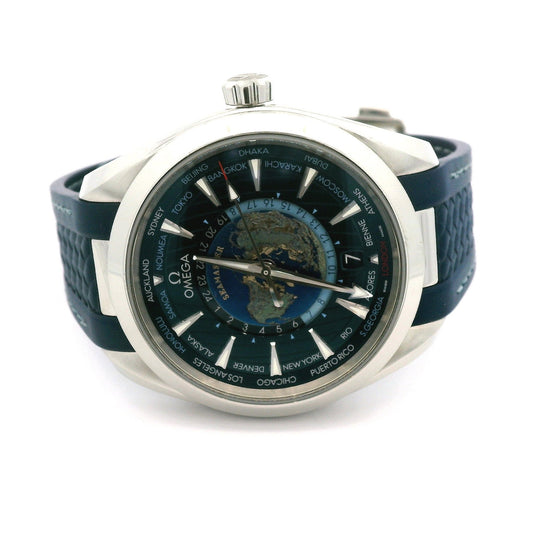
The Omega Seamaster Aqua Terra Worldtimer is one of the most distinctive world-time wristwatches in the modern Swiss watchmaking landscape — and one of the very few executions of the complication that uses a laser-ablated grade 5 titanium globe at the center of the dial rather than the more conventional flat continental map. Reference 220.12.43.22.03.001 is the steel-on-rubber-strap execution of that idea, paired with the Master Chronometer–certified Caliber 8938. This deep-dive walks through the Aqua Terra line's history, the world-time complication itself, the technical specifications of this specific reference, and the market context for a buyer evaluating this piece in 2026.
A Brief History of the Aqua Terra Line
The Aqua Terra collection was introduced by Omega in 2002 as a more refined, dressier counterpart to the Seamaster Diver and Planet Ocean lines — water-resistant enough for genuine sport use (originally 150 meters), yet finished and proportioned to wear under a cuff. The name itself — "Aqua Terra," water and land — was meant to telegraph that duality. From its launch the collection borrowed the Seamaster name and the wave-pattern dial heritage, but pulled in a cleaner case profile, applied indices, and a more architectural lug treatment.
In 2017, Omega refreshed the entire Aqua Terra collection. The most significant change was the move from a horizontal teak-pattern dial to a vertical teak pattern — straight, parallel grooves running top-to-bottom across the dial, evoking the deck planking of a luxury yacht. That redesign also brought twisted lyre-shaped lugs (a return to the Seamaster's late-1940s heritage), polished and brushed case finishes, and the introduction of the Master Chronometer Caliber 8900 family across the line.
The Worldtimer complication was added to the Aqua Terra line shortly afterward, as the most complicated execution within an otherwise sport-elegant collection. It positioned the Aqua Terra not just as a daily-wear desk-diver, but as a serious horological piece capable of showing all 24 time zones simultaneously.
The Worldtimer Complication: From Cottier to the Modern Wristwatch
The world-time complication as we know it was invented by Genevan watchmaker Louis Cottier in 1931. Cottier's "heures universelles" mechanism worked on an ingeniously simple principle: a static center dial showed the wearer's local time with conventional hour and minute hands, surrounded by a 24-hour ring rotating once per day, paired with an outer ring of 24 reference cities — one for each major time zone. To read the time in any city, the wearer simply looked at the 24-hour ring number aligned with that city's name on the outer ring.
Cottier first sold the complication as a pocket watch through Genevan jeweler Baszanger. In 1932, Vacheron Constantin commissioned him to build the reference 3372. By 1937, Patek Philippe had approached Cottier to produce the first world-time wristwatch — beginning a Patek world-timer lineage that runs through the celebrated references 1415, 2523, 5110, 5130, and the current 5230. Even today, the rotating 24-hour ring at the heart of the complication is referred to as a "Cottier-style mechanism."
The Aqua Terra Worldtimer takes that 1931 architecture and reinterprets it for the modern era. The 24-hour ring is rendered in two-tone blue lacquer — light blue for daytime hours, dark blue for night — which gives the wearer an instant day/night read across all 24 zones. The city ring carries 24 reference cities (with London printed in red, marking GMT/UTC as the system's anchor reference). And in place of the traditional flat continental projection, the Aqua Terra Worldtimer uses a three-dimensional grade 5 titanium globe, with continents engraved by laser ablation, viewed from above the North Pole. It is one of the most visually distinctive world-time dials in production.

The Aqua Terra Worldtimer Story: 2017 Platinum, 2019 Production, 2022 Refresh
The Aqua Terra Worldtimer made its debut in 2017 as an 87-piece platinum limited edition — a halo piece showcasing Omega's new caliber 8938 module and the laser-ablated titanium globe. At Baselworld 2019, Omega rolled the Worldtimer into regular production with the steel and Sedna gold cases, making it broadly available to collectors at a far more accessible price point than the platinum original. The 2022 model year — the year of the watch in this deep-dive — represents the most recent dial-and-strap configurations of that production run.
The summer blue dial of reference 220.12.43.22.03.001 is one of the defining configurations: a sun-brushed Summer Blue gradient with the vertical teak pattern, the laser-ablated titanium globe at the center, and the matching blue rubber "structured" strap with its diamond-pattern texturing that visually mirrors the dial.
The Caliber 8938: Master Chronometer Engineering
Reference 220.12.43.22.03.001 is powered by the Omega Co-Axial Caliber 8938 — a Master Chronometer–certified automatic movement built specifically for the Worldtimer complication on the Aqua Terra platform. It is derived from the caliber 8900 family that Omega introduced in 2015 to anchor its post-quartz, post-Co-Axial-rollout production strategy.
The caliber 8938 runs at 25,200 vibrations per hour (3.5 Hz), carries 38 jewels, and holds a 60-hour power reserve from twin barrels mounted in series — meaning the second barrel only begins discharging once the first is depleted, giving the movement a more linear torque curve and more consistent rate across the full reserve. The escapement is George Daniels' Co-Axial design, which uses radial impulses rather than the sliding friction of a Swiss lever escapement, dramatically reducing the need for lubrication and extending service intervals. The hairspring is silicon — non-magnetic, temperature-stable, and resistant to position-induced rate variation.
What separates Master Chronometer from standard COSC chronometer certification is the METAS protocol — eight separate tests administered by the Swiss Federal Institute of Metrology over a 10-day period. The accuracy criterion — 0 to +5 seconds per day — is significantly tighter than the COSC chronometer standard of -4/+6 seconds per day. And the magnetic resistance threshold (15,000 gauss) is among the highest in production watchmaking, bested only by purpose-built antimagnetic specialists. This is, in other words, one of the most technically rigorous mainstream production movements available at any price point.

Decoding the Reference Number
For 220.12.43.22.03.001:
- 220 — Seamaster Aqua Terra collection
- 12 — Stainless steel case on rubber strap (220.10 denotes the same case on the steel bracelet)
- 43 — 43mm case diameter
- 22 — Caliber family designation (8900-series Master Chronometer)
- 03 — Summer Blue dial with Earth globe
- 001 — Configuration variant
A buyer comparing pre-owned listings will frequently see the closely related references 220.10.43.22.03.001 (steel bracelet variant) and 220.12.43.22.03.002 / 220.10.43.22.03.002 (the Summer Blue iterations). All carry the same 43mm steel case and caliber 8938 — the differences are in dial finish and strap configuration.
The Dial: A Miniature Earth and the City Ring
The dial is the defining feature of this reference, and it deserves a dedicated breakdown.
At the absolute center sits a domed disc of grade 5 titanium, with all seven continents engraved into its surface by laser ablation — a process where focused pulses of light vaporize material with sub-micron precision. The orientation is azimuthal: the viewer is looking down at the Earth from directly above the North Pole, with all continents radiating outward.
Surrounding the globe is a 24-hour ring rendered in two shades of blue lacquer — a brighter, lighter blue covering the daytime hours and a deeper midnight blue for the nighttime hours. Read in combination with the city ring outside, this gives the wearer an instantaneous global day/night read.
Outside the 24-hour ring runs the polished steel city ring, listing 24 reference cities in raised printed lettering: Auckland, Sydney, Tokyo, Beijing, Bangkok, Dhaka, Karachi, Dubai, Moscow, Athens, Bienne, London (printed in red as the GMT/UTC anchor), Azores, S. Georgia, Rio, Puerto Rico, New York, Chicago, Denver, Los Angeles, Alaska, Honolulu, Samoa, and Noumea. Bienne, Switzerland, is the home of Omega's manufacturing operations — its inclusion is a quiet horological in-joke that only the brand-aware will catch.
Outside the city ring, the main dial surface itself carries the signature vertical teak pattern in a Summer Blue gradient — sunburst-finished from the center outward. Hour markers are applied facets in rhodium-plated white gold, filled with Super-LumiNova that emits a distinctive light blue glow in low light. The hands are sword-shaped, also rhodium-plated and lume-filled. The GMT/world-time arrow hand is broader and has a small red lume tip. The date aperture sits at 6 o'clock, integrated cleanly into the city ring.
The Case, Crystal, and Caseback

The 43mm stainless steel case follows the 2017-onward Aqua Terra design language: brushed top surfaces on the lugs and case sides, polished bevels along the lug edges and the case flanks. The signature twisted lyre lugs — an Omega Seamaster heritage cue dating back to the 1948 Centenary — give the case a more architectural, sculpted profile than the slab-sided earlier Aqua Terra references.
The conical Omega-signed crown sits at 3 o'clock and is screw-down, contributing to the 150-meter water resistance rating. The crystal is domed sapphire with anti-reflective treatment on both interior and exterior surfaces — important on a Worldtimer dial, where reflections can otherwise compete with the multiple concentric rings. The caseback is a sapphire exhibition window framed in the case, screwed down with engraved markers around the perimeter. Through the caseback the wearer sees the caliber 8938's rotor (engraved "OMEGA MASTER CO-AXIAL 8938"), the bridges, and the visible silicon hairspring at the regulator.
The Strap and Clasp
The factory blue rubber strap is one of the more intentional pieces of design language in the reference. It carries an embossed diamond/cordura-style pattern on its outer surface, designed to visually echo the vertical teak pattern of the dial. The interior face is smooth and contoured for comfort against the wrist, and the rubber compound is high-grade enough to resist UV degradation, chlorinated water, and saltwater exposure.
The strap terminates in a polished and brushed stainless steel deployant clasp with the Omega Seamaster logo engraved on the outer face. Closure is a butterfly fold-over with twin pushers — substantially more secure than a single-pin tang buckle and more comfortable for desk wear.
Market Position and Pricing
The Aqua Terra Worldtimer occupies a deliberate position in the market: it is Omega's most complicated daily-wear sport-elegant watch, sitting above the time-only Aqua Terra references and the GMT-only models, and below the Speedmaster chronograph executions in mechanical complexity (though arguably above them in practical horological usefulness for an international traveler).
Original retail for reference 220.12.43.22.03.001 is approximately $10,900 USD as currently listed by Omega. Pre-owned full-set examples in like-new condition typically transact in the $7,500 to $9,500 range, depending on age, condition, completeness of box and papers, and dealer reputation.
Compared directly to other Swiss world-time wristwatches in the production-watch market, the value proposition is clear:
- Patek Philippe World Time 5230G — approximately $55,000 retail
- Vacheron Constantin Overseas World Time — approximately $45,000 retail
- IWC Pilot's Watch Timezoner — approximately $13,000 retail
- Glashütte Original Senator Cosmopolite — approximately $15,000 retail
- Montblanc 1858 Geosphere — approximately $6,500 retail (though it's a dual-time, not a true 24-zone worldtimer)
For roughly $9,000 pre-owned, the Aqua Terra Worldtimer delivers a Master Chronometer–certified caliber, 15,000-gauss antimagnetic resistance, 60-hour power reserve, the sapphire caseback view, and the laser-ablated titanium globe — a combination of technical specification and visual distinction that simply doesn't exist anywhere else at this price point. The Patek and Vacheron are objectively more prestigious as nameplates, but they cost five to six times as much, and neither carries the Master Chronometer/METAS certification.
The Example Currently in the Forever Rox Fine Jewelry Showcase
We currently have a 2022 Omega Seamaster Aqua Terra 150M Worldtimer 43mm in stock at Forever Rox Fine Jewelry — reference 220.12.43.22.03.001, the Summer Blue dial on the original blue rubber strap. The piece is in like-new condition, with full box and papers, and is listed at $8,850.
This is a meaningful discount to the current Omega retail price, which makes it a strong value entry point for a buyer evaluating the Worldtimer in the secondary market. Like-new full-set examples of this reference rarely surface at this price point, particularly outside major metropolitan watch hubs.
 For a buyer in Lake Tahoe, Reno, Carson City, Truckee, South Lake Tahoe, or anywhere else in the country, the watch is available for in-store evaluation at our Incline Village location, or for shipped purchase with full documentation, condition reports, and a return window. As an independent fine jewelry and luxury watch dealer, Forever Rox Fine Jewelry has been authenticating and servicing high-horology pieces for the Tahoe basin since 1984.